
The 30-Day Clock: How Jensen Huang Saved Nvidia From the Brink of Extinction
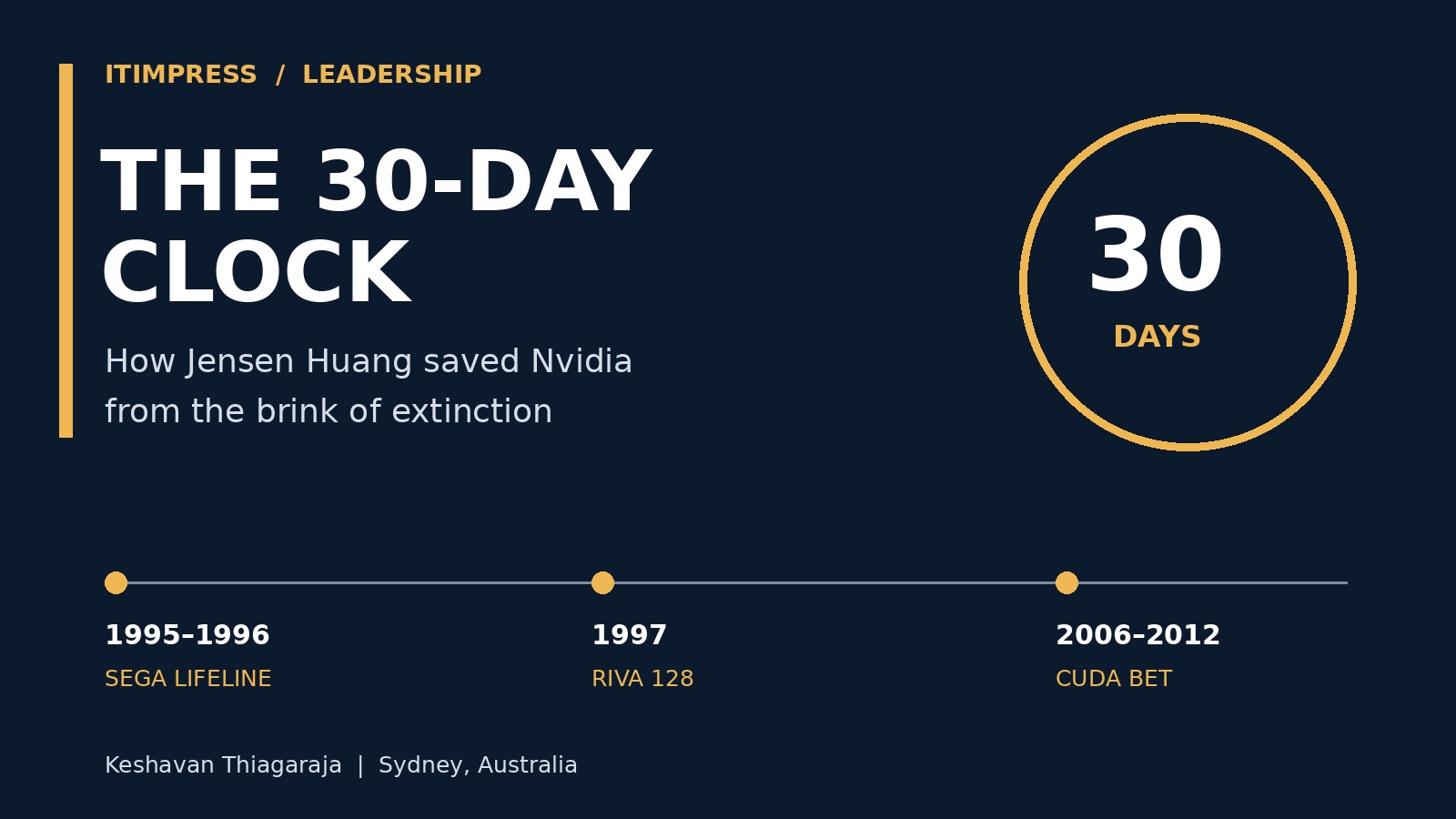
Introduction: How does a 30-day clock shape a company?
To the outside world, Nvidia looks like an unstoppable, multi-trillion-dollar juggernaut anchoring the global artificial intelligence revolution. Yet, inside the company’s Silicon Valley headquarters, a different mantra echoes through the halls. CEO and co-founder Jensen Huang frequently reminds his staff: "Our company is 30 days from going out of business."
This is not empty corporate hyperbole. It is a corporate philosophy forged in the fires of near-total annihilation. On at least three distinct occasions, Nvidia found itself staring down immediate bankruptcy. Each time, it was saved by Huang’s lethal combination of brutal honesty, extreme risk-taking, and stubborn long-term vision.
1. The Sega Lifeline (1995–1996)
In the mid-1990s, Nvidia was a struggling startup. Its first-ever graphics chip, the NV1, was designed to handle curved quadratic surfaces. It was a technical marvel, but a commercial disaster. Shortly after its release, Microsoft standardized triangle-based polygon rendering for Windows via DirectX.
Nvidia’s technology became instantly obsolete. The company was forced to cancel its next-generation NV2 chip, leaving them with just 30 days of cash reserves.
Facing certain death, Huang flew to Japan to meet with Shoichiro Irimajiri, the CEO of gaming giant Sega, who had contracted Nvidia for their upcoming console. Instead of trying to bluff his way through, Huang took a massive gamble on radical transparency. He openly admitted to Irimajiri that Nvidia’s architecture was a dead end and that the contract could not be fulfilled.
However, Huang added a desperate plea: if Sega canceled the contract without paying, Nvidia would fold. He asked for the final $5 million contract payment anyway, pitching it as an investment in Nvidia’s survival.
Recognizing Huang's talent and honesty, Irimajiri agreed. Sega converted the payment into an equity stake, buying Nvidia six crucial months of operational runway.
2. The "Hail Mary" of the RIVA 128 (1997)
Even with Sega's lifeline, Nvidia's survival was far from guaranteed. The company was heavily in debt and forced to lay off more than half of its workforce. They had enough remaining capital to build exactly one more chip.
In 1997, the standard industry practice was to manufacture physical prototypes, test them, fix the bugs, and re-manufacture. Nvidia could not afford this.
Huang decided to bet the entire company on a radical, unproven method: designing and testing a chip entirely inside software simulation. Because they couldn't afford a prototype phase, Huang sent the untested design straight from the computer simulation to the manufacturing factory.
It was the ultimate corporate "Hail Mary." If a single transistor was misplaced, the chip would fail, the money would be gone, and Nvidia would declare bankruptcy.
The gamble paid off spectacularly. The RIVA 128 worked perfectly on the very first try. It became an instant blockbuster, selling over one million units in just four months. This single chip single-handedly pulled Nvidia out of insolvency and paved the way for its 1999 initial public offering (IPO).
3. The Multi-Billion-Dollar CUDA Bet (2006–2012)
Nvidia’s third brush with disaster was not caused by a failed product, but by an incredibly expensive vision that Wall Street despised.
In 2006, Huang unveiled CUDA (Compute Unified Device Architecture). It was a software platform built into every Nvidia graphics card, allowing them to be used for general high-performance computing, not just video games.
For years, the move looked like a catastrophic mistake. Building CUDA required billions of dollars in research and development. It also required adding extra hardware components to every chip Nvidia sold, which severely crushed the company's profit margins.
Investors were furious. Wall Street heavily criticized Huang for destroying shareholder value on a niche technology nobody was using. Nvidia’s stock price plummeted by over 80%, wiping out billions in market value and leaving the company highly vulnerable.
Despite intense pressure to abandon the project, Huang refused to back down. He kept investing in CUDA, convinced that the world would eventually need massive parallel processing power.
His stubbornness changed the course of tech history. In 2012, AI researchers discovered that Nvidia’s CUDA-powered graphics cards were the absolute perfect engine for training deep neural networks. When the generative AI boom erupted a decade later, Nvidia had a monopoly on the software infrastructure required to build the future—a moat that started with a bet that nearly broke the company.
Conclusion: The Legacy of a "Near-Death" Culture
Today, Nvidia’s history of surviving near-extinction events informs how the company operates. By treating the company as if it is always just 30 days from collapse, Huang has hardcoded adaptability and paranoia into Nvidia's DNA. It is a stark reminder that tech giants are not built on flawless, linear success, but on the ability to survive the moments when everything goes wrong.
References
Powered By K7