
NVIDIA, Jensen Huang and key-person risk: why succession, independent oversight and business continuity matter
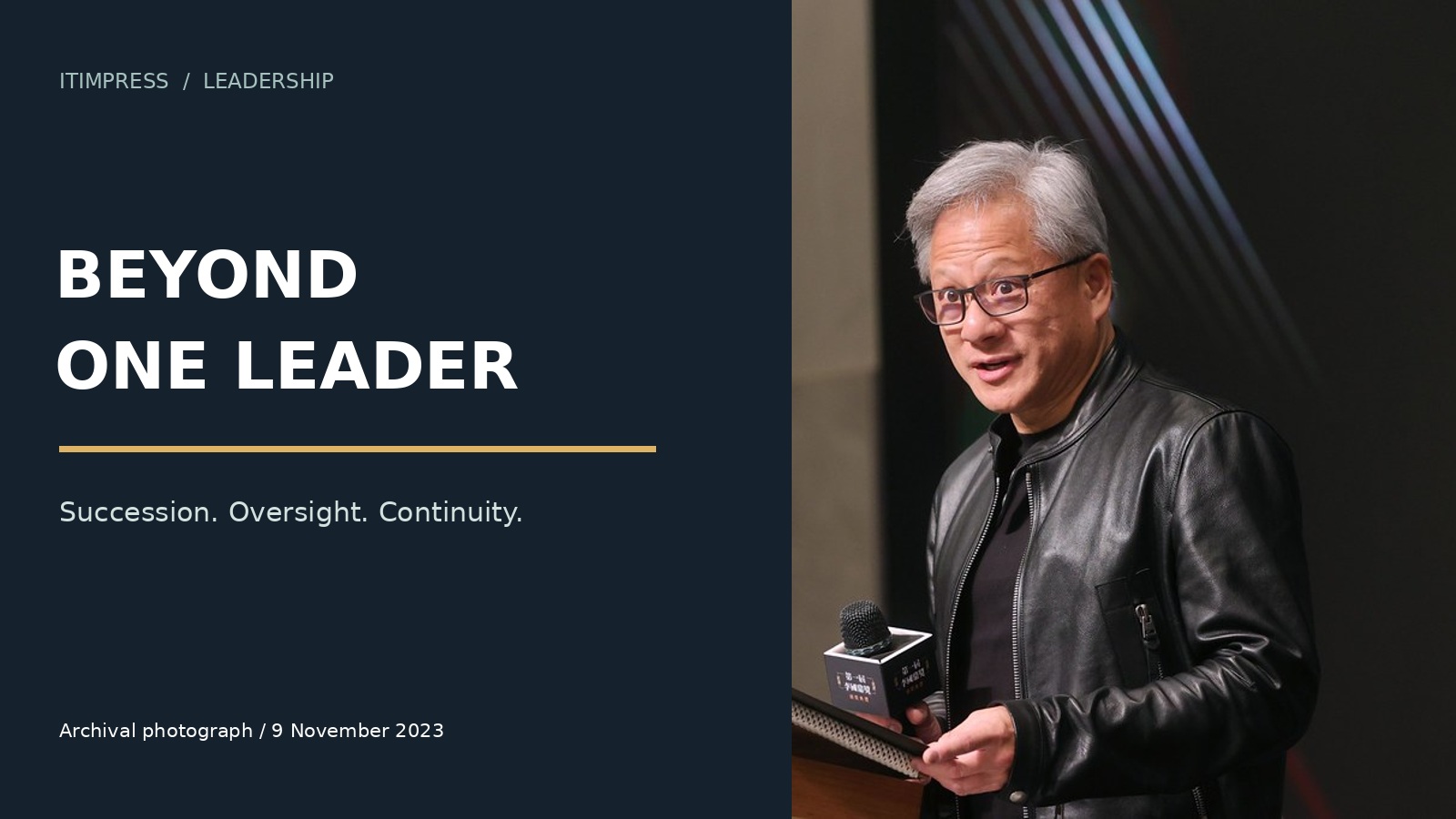

Introduction: can a strong company become too dependent on one leader?
I see a distinction between valuing a founder and allowing an institution to depend on that founder for everything. Jensen Huang's role at NVIDIA makes this a useful governance question. The lesson is not that strong leaders are undesirable. It is that their judgment, relationships and knowledge should strengthen an organisation that can keep working without them. Recent reporting about Huang brings that question into focus, but an investigation is not a finding of misconduct. [1,4]
1. Leadership strength and concentration risk are different things
NVIDIA's fiscal 2026 annual report says it is highly dependent on its longstanding executive team. It warns that ineffective succession planning, knowledge transfer and transitions could hinder strategy, execution and long-term success. This is a company disclosure about the executive team, not proof that every decision depends on Huang alone. The 9 November report raises concerns about founder dependence and describes an ongoing board investigation into reports of a foreign-intelligence effort. Those reports and suspicions must not be presented as established findings. Nor does the absence of a publicly identified successor prove that no confidential board plan exists. [1,4]
2. My test: does the institution work when the leader is unavailable?
I would ask who has authority during an unexpected absence, which decisions need a second review, where critical knowledge is recorded, and how customers receive reliable information. These are governance recommendations, not claims that NVIDIA lacks every safeguard. Its 2026 proxy describes an independent lead director, independent-director meetings and board risk oversight; its current committee page identifies audit, compensation and governance committees. The practical question is whether such structures can challenge management, manage conflicts and support a tested transition. For businesses buying critical technology, I would also examine contracts, support routes and continuity options rather than treat a founder's reputation as a substitute for due diligence. A continuity plan should be tested before a crisis, not improvised during one. [2,3]
Conclusion: respect the leader, strengthen the institution
My view is that succession planning is not disloyalty. It protects employees, customers, shareholders and the leader's work. A board should assess evidence fairly, preserve independent oversight and communicate what it can verify without turning allegations into verdicts. The goal is not to predict Huang's departure or recommend an investment decision. It is to build a company whose capability is larger than one person's availability.
References
Powered By K7