
What can founders learn from Jensen Huang's journey? 16 fresh questions on engineering, Sega, CUDA and company responsibility
Introduction: what is worth asking beyond a success story?
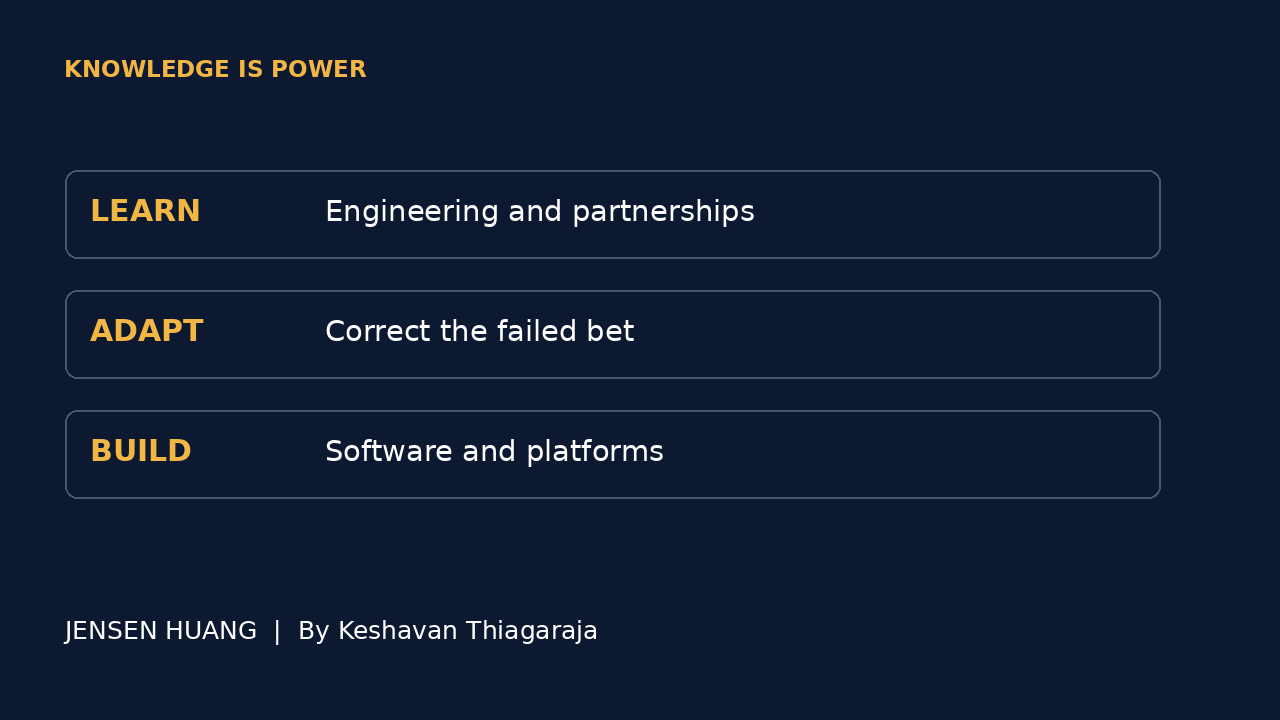
A useful founder biography should help readers ask better questions, not merely admire an outcome. These sixteen questions focus on engineering experience, partnership, technical failure, software and independent company oversight. They are a separate, focused explanation, with sources attached to each answer. Public facts are kept separate from practical editorial observations and unresolved reports. [1][2][6]
1. What engineering education did Jensen Huang complete?
NVIDIA's biography records a bachelor's degree in electrical engineering from Oregon State University and a master's degree in electrical engineering from Stanford University. This establishes an engineering background, not a guarantee of entrepreneurial success. The practical lesson is to distinguish the degree itself from habits such as testing assumptions, measuring constraints and examining a design's limits.
2. Where did Huang work before NVIDIA?
The official biography records AMD from 1984 to 1985 and LSI Logic from 1985 to 1993. These were semiconductor workplaces before NVIDIA's founding. That sequence matters because the founder's story did not start with a company registration. Earlier technical and industry experience belongs in the account, without assuming that every later decision can be traced to a particular former employer.
3. How did Jensen and Lori Huang meet?
Oregon State University describes them meeting as electrical-engineering laboratory partners. It records Jensen's graduation in 1984 and Lori's in 1985. The same university account identifies Lori as president of the family foundation. These public details support an account of a shared technical setting and her own public role, not speculation about their private life.
4. Did Huang found NVIDIA alone?
No. The Computer History Museum identifies Jensen Huang, Chris Malachowsky and Curtis Priem as NVIDIA's founders in 1993. Its account describes an early focus on advanced three-dimensional graphics for games and multimedia. Leadership should not be described in a way that erases co-founders or the work of engineers and other contributors.
5. Was today's computing business fully planned in 1993?
The historical account describes an early graphics and multimedia focus, followed by later technical milestones and applications. It does not establish that the founders had a complete plan for today's market. Looking backwards can make adaptation appear inevitable. A more useful business reading asks how capabilities and applications changed, rather than inventing a perfectly predicted future.
6. What does the Sega episode illustrate?
Inc's December 2024 account describes Huang acknowledging that NVIDIA could not deliver the contracted chip and reports that a subsequent US$5 million Sega investment gave the company time. This illustrates a specific response to a failed technical direction. It does not show that every counterparty will provide money, or that admitting a mistake alone is enough to save a company.
7. Did an investment by itself solve the early crisis?
No. In Inc's account, the time bought by funding was followed by technical work, simulation-led design and the RIVA 128 product's role in recovery. Cash creates runway; it does not automatically create a working product or customer demand. A founder must connect available time to decisions and delivery, while keeping the safeguards appropriate to the product.
8. Should founders copy the historical testing shortcuts?
Not as a general rule. Inc describes choices under particular time and money constraints. Another company must assess its own failure costs, legal duties and safety requirements. The useful question is how to reduce risk within constraints, not how to turn a historical survival story into permission to skip necessary tests.
9. Why are GeForce 256 and CUDA different milestones?
The Computer History Museum identifies the GeForce 256 release in 1999 and CUDA's introduction in 2006. The former belongs to the graphics hardware story; the latter helped programmers use GPU resources for broader computational work. Neither milestone supports claiming that NVIDIA invented all graphics computing or all artificial intelligence.
10. What do host and device mean in CUDA?
The CUDA programming guide uses host for the CPU and device for the GPU. An application can begin on the host and run suitable work on the device through kernels. Kernels use many threads. This model explains a division of work, not a promise that moving any arbitrary application to a GPU will make it faster.
11. Why does software matter when the chip is powerful?
The CUDA model still requires work division, data movement, memory management and synchronization. Hardware capability is only part of the application. A technology buyer should measure complete task time, cost and correct results under its own workload. A faster component does not guarantee a faster complete service when another stage remains the bottleneck.
12. Does the AlexNet milestone make NVIDIA the sole creator of AI?
No. The Computer History Museum discusses NVIDIA GPUs in the 2012 AlexNet breakthrough, but researchers, software, data and computing resources all matter to that history. A hardware contribution should be described as a contribution. It should not erase the people and other work that made the application possible.
13. What educational gift is documented by Oregon State?
The university's March 2023 account connects Jensen and Lori Huang's US$50 million gift with the Collaborative Innovation Complex and describes ambitions for research across disciplines. That source establishes the announced gift and aims. Its older opening target is not a current check of whether a building has opened or what facilities are available now.
14. What did NVIDIA's board announce on 8 November 2026?
The board said it was beginning an independent investigation following reports of a foreign intelligence effort, overseen by a committee of independent directors with outside independent legal counsel. Its statement also gave the board's position at that time on national security and company secrets. The announcement of an investigation is not a final finding.
15. How should readers handle unresolved company reports?
Separate the allegation, the company's response and any established conclusion. The board's statement describes its position and an investigation process; it does not complete that process. Do not turn an unresolved report into a proven claim, and do not use a founder's reputation as proof that questions need not be examined. This Q&A avoids speculation about individuals.
16. What is the most useful question for a small business?
Ask which assumption needs testing next. It might concern a technical choice, cash runway, a customer outcome or the independence of decision review. The historical episodes give examples to think with, not a guaranteed success method. These are practical editorial observations, not investment advice or a forecast of any company's performance.
Conclusion
The strongest lesson is to keep checking the evidence. A degree is not a business guarantee, funding is not a finished product, and a founder's confidence is not a substitute for governance. Use the history to test assumptions and improve decisions, while keeping every claim within what its source establishes. [1][3][6]
References and further reading
- NVIDIA: Jensen Huang official biography
- Computer History Museum: Jensen Huang, 2024 Fellow
- Inc, 13 December 2024: early survival and Sega investment
- Oregon State University, 28 March 2023: engineering alumni and philanthropy
- NVIDIA CUDA Programming Guide: programming model
- NVIDIA Board of Directors statement, 8 November 2026
By Keshavan Thiagaraja
Private AI Model Developer & AI Security Consultant - Helping SMEs and Enterprises Build Secure AI Solutions, Sydney, Australia
B.Sc. (Computer Science, Mathematics and Statistics)
M.Sc. (Information Technology)
E-Commerce Professional
Powered By K7