
From engineering classrooms to a computing platform: what does Jensen Huang's journey teach about learning, partnerships, failure and leadership?
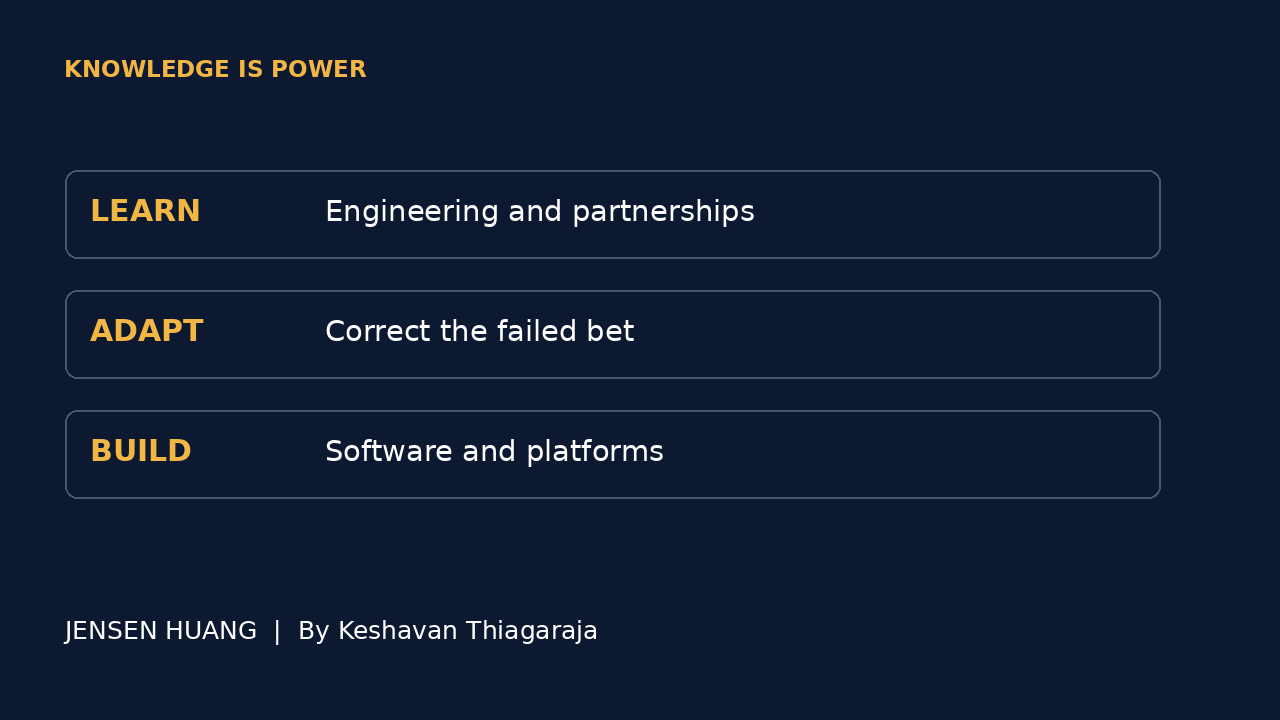
Introduction: why look beyond the company's valuation?
Reading Jensen Huang's life only through NVIDIA's market value leaves much of the story unexplained. Engineering education, colleagues, a willingness to change a failed technical bet, cash flow and developer trust connect different parts of the journey. NVIDIA did not become a computing platform in one announcement. Its history raises a more useful question: how can a product become something other people build upon? This account connects biography with business lessons without treating a founder's reputation as a substitute for evidence. [1][2]
1. Engineering habits matter more than the degree label
NVIDIA's official biography records Huang's bachelor's degree in electrical engineering from Oregon State University and master's degree in electrical engineering from Stanford University. It also records his work at AMD from 1984 to 1985 and LSI Logic from 1985 to 1993. He had worked inside semiconductor businesses before co-founding NVIDIA. Entrepreneurship is not another word for rejecting education. Measuring a problem, understanding constraints and testing a design are engineering habits that can inform business decisions too. The record supports that background; it does not prove that a particular qualification guarantees business success. [1]
2. A classroom partnership can have a long life
Oregon State University describes Jensen and Lori Huang meeting as electrical-engineering laboratory partners. Jensen graduated in 1984 and Lori in 1985. The account is more than a personal anecdote. It shows a shared technical setting and experience of working together. The university also identifies Lori as president of the family foundation. Her public contribution should not disappear inside someone else's fame. A careful biography distinguishes what the source says about each person rather than using marriage as a reason to overlook one person's own work. [4]
3. NVIDIA had three founders
Huang founded NVIDIA in 1993 with Chris Malachowsky and Curtis Priem. The Computer History Museum describes its early focus on advanced three-dimensional graphics for games and multimedia. It would be misleading to rewrite that beginning as a complete plan for today's market. The useful history is of a team addressing a specific need and adapting as applications changed. A founder's leadership can matter without making co-founders, engineers, customers and other contributors vanish from the account. [2]
4. Admitting a failed bet is a business skill
A December 2024 Inc account describes NVIDIA's early difficulty with a Sega project. In the historical account it cites, Huang told a Sega executive that NVIDIA could not deliver the contracted chip. Inc reports that a subsequent US$5 million Sega investment bought the company time. This does not mean every mistake will attract a rescue investment. The lesson is narrower: when the technical direction is wrong, explain the problem to the counterparty and seek another route rather than spending indefinitely on the same failed assumption. It is one historical episode, not a formula that promises survival. [3]
5. Turn financial runway into a working product
Funding does not save a business on its own. Inc describes NVIDIA using simulation tools to accelerate its design process, followed by the RIVA 128 product's part in the company's recovery. The lesson is not to avoid testing. The engineering question is how to reduce risk within the time, money and testing opportunities available. A company drawing on this episode must still assess its own safety requirements and the cost of failure. A historical shortcut is not permission to skip safeguards in a different product or industry. [3]
6. From graphics to more general computation
The Computer History Museum identifies the 1999 GeForce 256 release and the 2006 introduction of CUDA as milestones. A GPU marketing claim should not be stretched into a claim that NVIDIA invented all graphics computing. CUDA's important change was helping programmers use processing resources associated with graphics for other computational work. The story therefore became about more than chip speed. It also became about which problems people could solve using that hardware, and which software tools made doing so practical. [2]
7. Software is not decoration for hardware
The CUDA programming guide describes the CPU as the host and the GPU as the device. An application can start on the CPU and run suitable computational work on the GPU. A GPU kernel carries out work through many threads. Even this basic model shows why software matters: owning a fast chip is not enough. Work division, data movement, memory and synchronization must fit the application. A business buying technology should measure the time, cost and correctness of the complete application rather than rely on the device's name. [5]
8. New applications can give earlier investment another purpose
The Computer History Museum discusses NVIDIA GPUs in the 2012 AlexNet breakthrough. That does not establish that one company created all artificial intelligence. Researchers, software, training data and computing resources worked together. For founders, a useful question is whether other people can test the product and discover applications its creators did not anticipate. Making that possible takes long-term investment. It still offers no guarantee that every tool, developer programme or new application will succeed. [2]
9. Giving back to engineering education
Oregon State University's March 2023 account connects Jensen and Lori Huang's US$50 million gift with the Collaborative Innovation Complex. It describes a project intended to support work across disciplines. This is evidence of the announced gift and the project's aims. It is not a current building-status check, so the opening target in that older article should not be presented as today's completed state. Educational giving can be considered through both the amount announced and the opportunities students and researchers receive over time. [4]
10. Governance must stand beyond confidence in a founder
In a statement dated 8 November 2026, NVIDIA's board said it was beginning an independent investigation following reports of a foreign intelligence effort. It said a committee of independent directors would oversee the work with outside independent legal counsel. The board's stated position at that time, that it had no reason to believe national security or company secrets had been compromised, is not the investigation's final finding. Responsible reading separates allegations, a company's response and established conclusions. This account does not speculate about individuals. [6]
11. What can a smaller company use?
This history does not provide a checklist for copying a famous leader. It provides questions. Can a wrong technical choice be changed? Can a cash-flow problem be discussed before the money runs out? Is customer use being tested rather than assumed? Does the company have a way to review decisions beyond an individual's reputation? These are the author's practical observations from the history, not investment advice or predictions of NVIDIA's future performance. Their value depends on honest application to the smaller company's own constraints. [3][5][6]
Conclusion
Huang's journey is more useful as a study of connected decisions than as a story of inevitable success. Engineering experience, partnerships, a changed technical direction and a software ecosystem all belong in the account. So does governance that can examine difficult questions independently. For a founder, the next useful step is not to imitate a personality. It is to examine one technical assumption, one customer outcome and one decision-making safeguard in the business as it exists today. [1][3][5][6]
References and further reading
- NVIDIA: Jensen Huang official biography
- Computer History Museum: Jensen Huang, 2024 Fellow
- Inc, 13 December 2024: early survival and Sega investment
- Oregon State University, 28 March 2023: engineering alumni and philanthropy
- NVIDIA CUDA Programming Guide: programming model
- NVIDIA Board of Directors statement, 8 November 2026
By Keshavan Thiagaraja
Private AI Model Developer & AI Security Consultant - Helping SMEs and Enterprises Build Secure AI Solutions, Sydney, Australia
B.Sc. (Computer Science, Mathematics and Statistics)
M.Sc. (Information Technology)
E-Commerce Professional
Powered By K7