
Nvidia beyond the chip: open source, AI factories and the infrastructure advantage
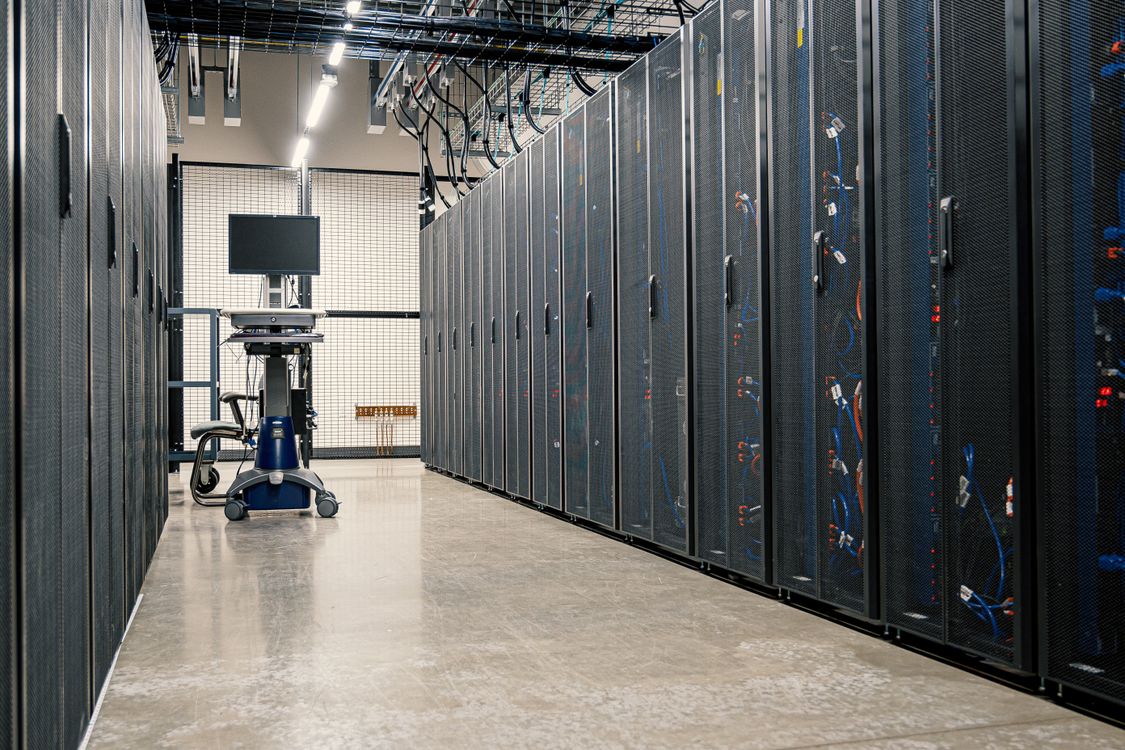
Nvidia is selling an infrastructure, not merely a chip
Analysis | November 13, 2026. Nvidia is the dominant supplier of high-end chips used to train and run AI models in data centres, with industry estimates placing its global share at around 80%. Its importance extends beyond the processors themselves into software, developer tools, cloud services and engineering practice. Replacing this working computing platform is a much larger task than designing a competing processor. Market share measures a defined market, not a census of every AI company or proof of exclusive dependence.
The shift from retrieving stored information to generating context-dependent answers in real time changes the economic role of computing. An AI system performs computation to produce its output, rather than merely delivering a prerecorded file. The AI-factory idea follows from this change: infrastructure becomes part of the production process for digital services. The commercial test is whether that output is useful enough to earn more than it costs to deliver.
Open source is part of the engine, but CUDA is not all open source
Open source lets researchers and developers inspect, modify and share software under its licence. It makes collaboration possible across companies and countries. PyTorch illustrates that shared foundation: its move to the Linux Foundation brought together members including AMD, AWS, Google Cloud, Meta, Microsoft Azure and Nvidia. Open AI software is therefore not the property or achievement of one chip company.
Nvidia participates in this system while also retaining proprietary components. Its CUTLASS library is released under a BSD licence, and its Linux GPU kernel modules use dual MIT/GPL licensing. But open kernel modules do not make the entire driver, firmware or CUDA Toolkit open source. The toolkit has its own licence and restrictions. Free to download, open source and open weights are different descriptions, and each component must be checked separately.
Open models serve three connected purposes: understanding future model architectures, allowing AI to spread beyond a few proprietary suppliers, and supporting domains such as biology, physics and robotics rather than language alone. Nemotron 3 Super provides a concrete example. Nvidia describes it as a hybrid Mamba-Transformer mixture-of-experts model with 120 billion total parameters and 12 billion active parameters, with released checkpoints, datasets and recipes. Those published materials demonstrate a specific form of openness; they do not make every Nvidia product unrestricted.
The advantage is the route from an idea to a running system
CUDA supplies a programming platform, compiler, libraries and tools for GPU-accelerated applications. A researcher can use a higher-level framework without writing every operation directly in CUDA. Beneath that framework, however, implementation choices still affect how a workload uses memory, executes calculations and communicates across devices.
CUDA’s installed base is a central competitive advantage. Supported software, trained engineers, debugging tools and familiar deployment paths reduce the uncertainty of putting a model into production. A rival competes with that working combination, not simply with the number printed on a chip specification. Replacing it may require adapting software, validating results and rebuilding operating expertise. The difficulty is real, but its cost varies by workload; it is not permanent lock-in.
OpenAI and the cloud: substantial dependence, not a universal monopoly
ChatGPT is a service from OpenAI, not a separate chip buyer in this comparison. OpenAI’s September 2025 announcement described Nvidia as a preferred strategic compute and networking partner and announced a letter of intent to deploy at least 10 gigawatts of Nvidia systems. It also described Nvidia’s intention to invest up to $100 billion progressively. These are dated announced plans, not evidence here that the full capacity has been commissioned or the full investment paid.
Cloud infrastructure gives customers another route to Nvidia hardware without buying their own servers. AWS, for example, documents EC2 P5 instances using Nvidia H100 GPUs and P5e/P5en instances using H200 GPUs for training, inference and high-performance computing. The cloud provider supplies a service around the hardware, including networking and capacity management. That is a wider relationship than a chip transaction.
Nvidia dominates the wider market, but alternatives already handle significant work. Google trained Gemini 2.0 on its own Trillium TPUs. AWS has reported Anthropic workloads running on Trainium2 infrastructure in Project Rainier. These are real alternatives, not proof that every competing platform is cheaper, faster or equally available for every task. The practical picture is substantial reliance on Nvidia across the AI industry alongside selective substitution, rather than universal exclusive dependence.
Beyond chat: healthcare, robotics and computing near the sensor
Nvidia’s documented platforms extend into medical imaging, genomics, drug-discovery research and robotics. Its healthcare materials describe MONAI for medical-imaging AI and Parabricks for genomics, while IGX is designed for industrial, robotic and medical edge applications. These are product capabilities and intended uses. They are not proof of a cure, clinical approval or deployment in every hospital.
The distinction between a data centre and the edge is important. A central system can supply large shared computing resources; an edge system processes information nearer a camera, machine or other sensor. As an analytical matter, this can make local response and selective data transmission valuable. Different environments still impose different power, reliability and safety requirements. One architecture appearing across several domains does not mean one identical device is suitable everywhere.
Nvidia has reached space, but an orbital AI factory is a different claim
There is a specific, documented space example. A June 2023 Jet Propulsion Laboratory presentation lists four Nvidia Tesla T4 GPUs in HPE’s Spaceborne Computer-2 package aboard the International Space Station. The same programme examined other processors too. This supports Nvidia hardware being used in an orbital computing experiment; it does not establish that Nvidia powers every satellite or that its GPUs were the first GPUs ever flown in space.
NASA’s account of the Spaceborne Computer programme explains the radiation problem and HPE’s software-based approach to monitoring and slowing systems when necessary. That experience shows why orbital computing is an engineering problem, not just a matter of moving servers above the atmosphere. Radiation, redundancy, power and heat rejection all matter. Processing imagery near a satellite’s sensors is a different proposition from building a large orbital AI factory. The latter should remain an outlook, not be presented as a solved cooling problem or a confirmed delivery schedule.
Valuation: distinguish the market’s price from a forecast
Market data checked for this article placed Nvidia’s equity market value at approximately US$4.01 trillion around the November 12, 2026 US close. This is a dated, rounded estimate, not a live November 13 US trading quote. Market capitalisation values the equity; it is not annual revenue, cash in the bank or a valuation of AI’s total benefit to society.
A future US$10 trillion valuation or US$3 trillion in annual revenue belongs to an ambitious growth scenario, not to the record of achieved results. The case for such expansion rests on AI factories creating new demand rather than merely taking share in an existing market. Whether that demand becomes profitable depends on customers paying for useful output, infrastructure costs and continued technical progress. These figures are possibilities discussed in a long-range outlook, not targets endorsed or guaranteed by this analysis.
The next constraint is the whole factory
The relevant unit of computing has expanded from a GPU to a computer, a cluster and now a whole AI factory. OpenAI’s announced infrastructure plans and AWS’s descriptions of GPU clusters show why networking and deployment matter alongside processors. Power, cooling, software reliability and utilisation must be assessed together. Buying accelerators is not the same as operating a productive service. Planetary-scale computing remains a longer-term direction, not a completed capability.
Open source can widen participation and make software more adaptable. It does not supply electricity, remove hardware costs or guarantee that an application will pay for itself. Equally, proprietary hardware and software can provide useful performance without making a customer’s dependence permanent. The balance between shared tools and commercial platforms is a continuing contest, not a settled law of the industry.
Conclusion: difficult to replace is not impossible to replace
Nvidia’s importance lies in the combination: accelerated computing, a mature software platform, developer confidence, cloud access and applications extending from research laboratories to an experiment in orbit. Its open work helps more people build on that infrastructure, while proprietary layers remain commercially important. The right question is not whether a competitor can copy a GPU. It is whether an alternative can deliver the complete, reliable system that a particular customer needs.
That makes Nvidia difficult to replace in many settings, but not irreplaceable in every setting. Google’s TPUs and AWS’s Trainium already prevent that absolute claim. Nvidia’s future will depend on continuing to turn engineering and ecosystem reach into useful work at an acceptable cost. A large valuation reflects expectations about that future; it does not guarantee it. This is editorial analysis, not investment advice.