
From Helpful AI to Controlled Action: Why Enterprise Agents Need an Enforced Boundary
Introduction: Who Decides What an AI Agent May Do?
An AI assistant can produce a useful answer without changing anything outside a conversation. An agent connected to business systems faces a different test. It may read a customer file, call a service or propose a payment. The important question is no longer only whether its answer sounds right. It is whether each action is permitted, for this person, on this record, at this moment. Recent open-source policy-engine research brings that distinction into focus. The business lesson is broader than any one project: instructions guide a system, but access controls must constrain what it can actually do.
1. A Prompt Is Not an Access Control
Writing 'do not send confidential information' is useful guidance. It does not remove a broad credential or disable an unnecessary export function. The excessive-agency guidance recommends limiting available functions, reducing downstream permissions and enforcing authorization in the systems that execute requests. A document-reading task should not inherit deletion rights merely because the same connector offers them. Start with the smallest useful action set, then check every request against the intended scope.
2. Identity and Permission Are Different Questions
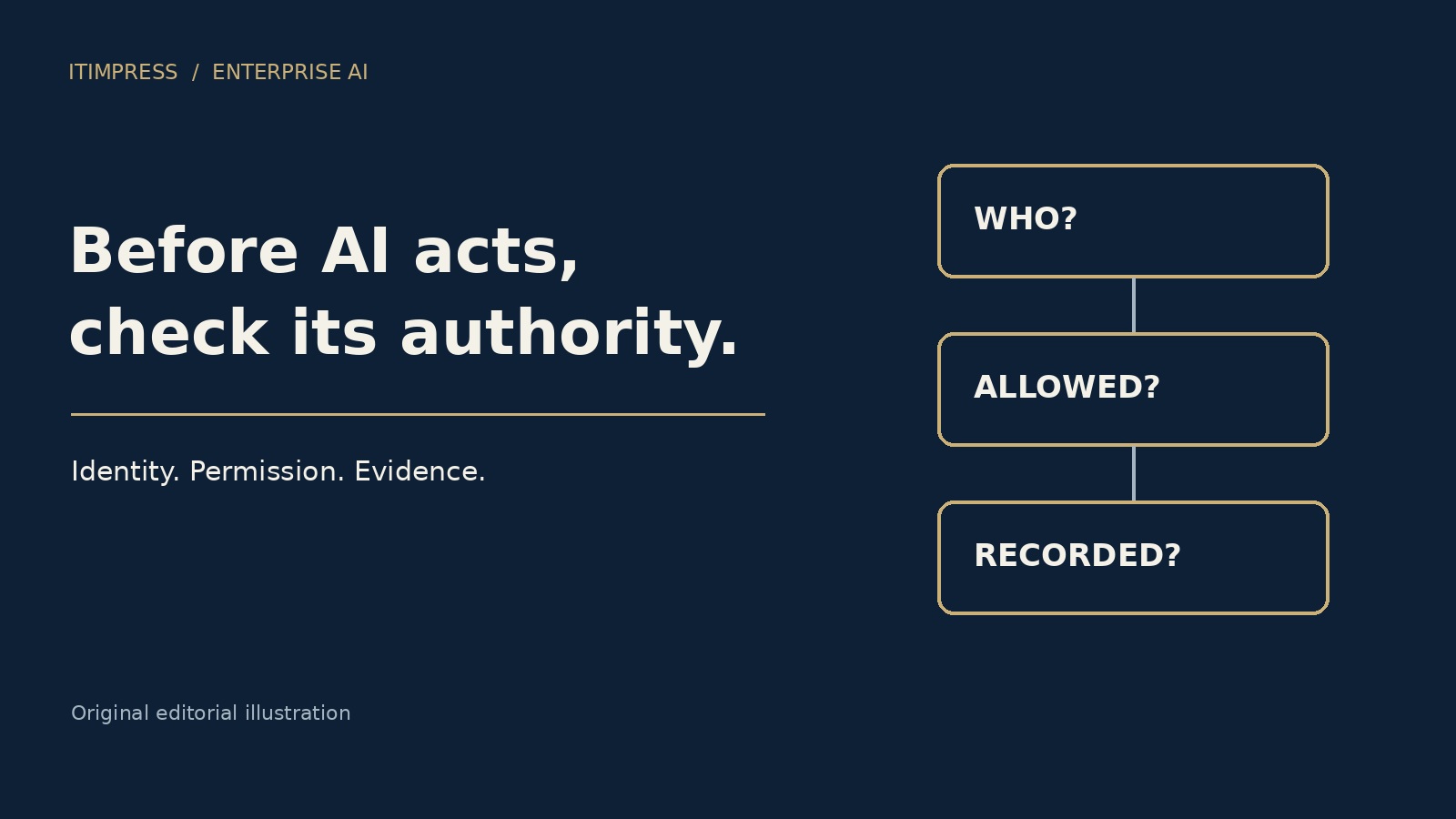
A verified identity answers who is making a request. It does not, by itself, establish permission to make that request. Zero-trust architecture treats authentication and authorization as distinct functions. For an enterprise agent, the decision should connect the requesting person, the software identity, the specific resource and the proposed action. A shared administrator account makes that separation harder. Prefer scoped access that preserves the relevant user context rather than granting every workflow the same broad authority.
3. Place the Check Where the Action Happens
A policy service can allow, deny or require approval before a tool request reaches its destination. But the placement matters. A gateway protects traffic routed through it; it cannot be assumed to govern an alternative route that bypasses it. Host isolation and network controls address different paths. Map local files, subprocesses, network services and delegated calls before claiming coverage. Test a forbidden action through every available path, not only through the normal demonstration.
4. An Audit Record Is Evidence, Not Automatic Proof
Recent policy-engine work describes decision records, with optional signatures and hash chaining to help detect later changes. These features can strengthen an investigation. They do not prove that the policy was correct, that every path was covered or that a permitted action was a good business decision. Record the identity, resource, requested action, decision and approval reference. Protect the records from unnecessary sensitive content, and test whether a reviewer can reconstruct a real incident.
5. Run a Small, Deliberately Difficult Pilot
Choose one workflow with a clear owner and a measurable outcome. Give it only the records and actions it needs. Try an expired approval, an unrelated customer record, an instruction embedded in a document and a request to use a different destination. Define what must be denied and what must wait for a person. Check failure behavior when the policy service is unavailable. A successful pilot should demonstrate controlled refusal as clearly as successful execution.
Conclusion: Measure Authority Before Autonomy
Early-stage open-source work is a useful engineering reference, not a production guarantee. Enterprise leaders should ask for evidence of enforced scope, bypass testing and usable incident records before widening access. The aim is not to make every action slower. It is to make permitted work dependable and prohibited work difficult to perform. Better reasoning helps an agent choose an action. Enforced authority determines whether the business should allow it.
References
Powered By K7